Chapter 1
The Problem
During World War II, the Allied forces were losing bombers at an alarming rate. Each plane sent on a mission was a precious resource, and each crew was irreplaceable. The military knew they needed to add armor to the planes, but there was a catch.
The weight penalty
You can't just armor the entire plane. Armor is heavy. A plane weighted down with too much steel would be slow, hard to maneuver, and consume too much fuel. It wouldn't be able to carry enough bombs to complete its mission.
The military had to be selective. They had to find the most vulnerable areas and reinforce them without sacrificing the plane's performance.
The damage map
To solve this, the military began mapping every bullet hole and piece of shrapnel damage on the bombers that returned from their missions. They created a composite diagram that showed where the planes were being hit most often.
The data showed a very clear pattern: bullet holes were concentrated on the wings, the fuselage, and the tail. There were almost no bullet holes in the engines or the cockpit.
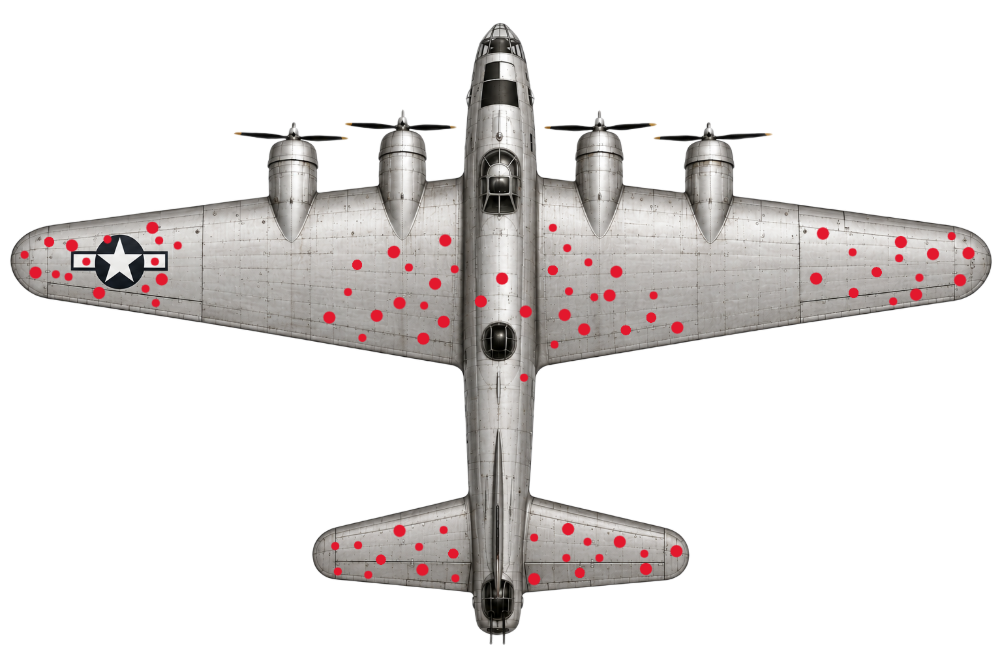
Every red dot represents a hit recorded on a bomber that successfully returned from a mission.
The Logical Trap
Think about how we usually solve problems. If your roof is leaking, you patch the hole where the water is coming in. If your shoes are wearing out at the heels, you reinforce the heels.
The military used this same "common sense." They looked at the diagram and saw where the planes were getting "beaten up" the most. To them, the conclusion was inescapable: the wings and tail were the most vulnerable parts of the aircraft.
Quick Check
Did you get the key idea?
Why couldn't the military just add armor to the entire plane?
The damage map showed bullet holes concentrated on the wings and tail. What did most military planners initially conclude?
Continue reading
Chapter 2: The Insight →